Many modern entrepreneurs find themselves in the midst of complicated accounting terms at the beginning of their business careers. Due to various legal regulations, business owners need to take care of numerous administrative details.
Invoices and sales receipts represent two crucial financial documents in every business collaboration. The former contain every single information about your company and your products, as well as their prices. The latter are often described as reduced invoices.
However, it’s an overly simplified approach to sales receipts. In this article, we’ll discuss sales receipts to greater details, so as to educate you when and how to use these documents.
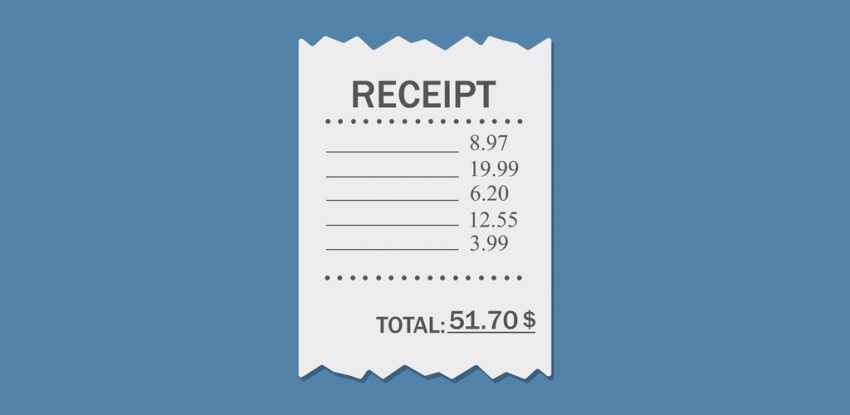
What is a sales receipt?
In a nutshell, a sales receipt is a financial document shorter than an invoice. According to a definition provided by Business Dictionary:
Sales receipt is a document which typically shows the date and time a purchase was made, items purchased, amount of purchase price and totals, the name and location of store/entity where the purchases were made, and supplemental information concerning store returns, the method of payment used and other relevant sales-related information. Sales receipts are often necessary for store returns or exchanges.
As opposed to an invoice, a sales receipt contains less information. It’s meant for smaller purchases, in order to simplify the process of invoicing.
Apart from that, a sales receipt is a proof for purchased products or services. That way, a sales receipt should be issued to customers who need tangible evidence that they’ve made a purchase at once.
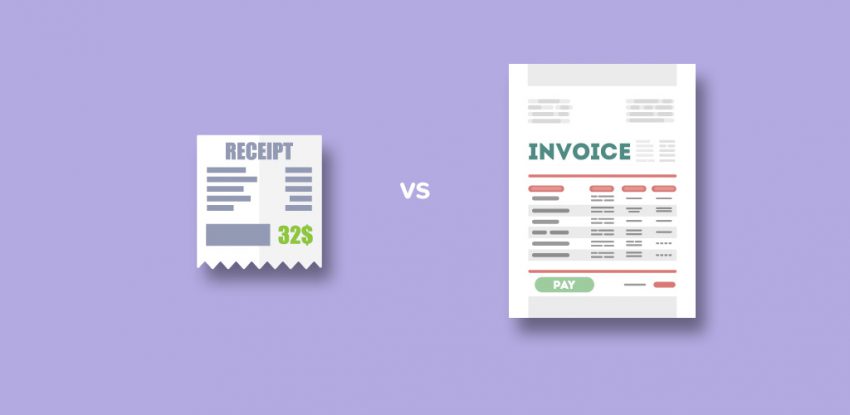
When to use an invoice and when a sales receipt?
When you issue an invoice, your payment will arrive after a particular period of time. So, you should create invoices and receive payments against them in case of deferred payments. You can set your own terms to instruct how long the customer has to pay. If they don’t pay within the given timeframe, their invoice becomes due/overdue.
On the other hand, a sales receipt should be used for immediate payments. For example, when your customer pays you on the spot for goods or services.
In other words, invoices are sent before the payment is made while sales receipt are sent after (usually as a confirmation of payment).
However, some jurisdictions require invoices to be issued over sales receipts if the price of a product/service surpasses a certain amount. For this, price thresholds vary from country to country, as well as from state to state.
For instance, in the UK, business owners are allowed to use a sales receipt instead of an invoice for any purchase that doesn’t go over £250 (VAT included).
On the other hand, Irish entrepreneurs can issue sales receipts if they buy goods that don’t exceed €100. By giving the advantage to sales receipts over invoices, the financial authorities want to simplify the shopping procedure and encourage businesses to increase the level of collaboration.
What should a sales receipt contain?
Now that we’ve established the difference between sales receipts and invoices, we’re going to point out what elements you have to include in your sales receipts and what features can be left out. Here’s what a sales receipt needs to have:
- The name of your business and your physical address – It should be placed at the top of the sales receipt.
- Your very own invoice number – You can start numbering your sales receipts/invoices from any number that you choose. For instance, you can start from 1 or from 100. Also, you can choose to assign the numbers of your sales receipts in a chronological order or other practical ways. It’s completely up to you, but make sure they are unique for each purchase.
- The description of the products and services – You have to describe the purchased goods. However, these details don’t have to be too detailed.
- The date of the sale – This is an important point because it expresses the time of supply, which is crucial for taxation since it contains the tax point.
- Your own VAT number (if you are VAT registered) – Although sales receipts are shorter versions of invoices, they still need to display important tax information.
- VAT-rates per item – One of the major tax details, so add these rates to every sold/purchased item.
- Total sum with VAT – There should be a note stating that the sales receipt includes VAT at the end of it.
What can you leave out?
Since the aforementioned elements can’t be left out from a sales receipt, here’s what you don’t have to include in this financial document:
- Customer’s name and address
- Price per product excluding VAT
- The date of issue
- The quantity of each type of product or service
- The total amount excluding VAT
- Discounts and special rates per product
When your purchase stays within the price limits determined by the financial authorities, you’ll save a lot of time and energy on those smaller purchases.

Production benefits of using sales receipts
Sales receipts can be used for both domestic and international purchases in equal measure. The greatest benefit of using these forms is that they’re fully valid reports that can replace demanding invoices.
As a result, you can sell more items per period of time. If goods from your stock are sold in a faster way, you can increase the production rate.
To top it all off, this is a two-way process. On the one hand, buyers can order more goods from their suppliers. On the other, suppliers can produce and provide more products for their customers.
So, reducing the number of administrative details, such as detailed invoices, has a beneficial effect on the economy, leading to greater productivity and a larger number of business deals.
Sales receipts for smooth business collaboration
Enabling entrepreneurs to use sales receipts shows that businesspeople can profit from loosened economic regulations. Furthermore, if businesses have higher revenues, the authorities will collect more taxes.
Nevertheless, the greatest problem of many communities is that governments overregulate the economy and business deals. If there are too many rules in a particular market, it’s more difficult for business owners to organize their business and make the ends meet.
Because of that, both business owners and managers should insist on introducing simplified bureaucratic procedures.
Sales receipts still can’t completely replace invoices.
Truth be told, increasing the price threshold for sales invoices could also lead to some undesired tax evasions.
However, the authorities and the business community should work together on finding the most viable solutions for more advanced use of sales receipts. If they manage to come up with original ideas for this purpose, they could improve the overall efficiency of the local economy, as well as (inter)national business deals.
The bottom line is that the entire community would benefit from giving more space to simpler financial forms, such as sales receipts. Until that moment, you should use sales receipts in accordance with the price threshold rules and make them work for your business as efficiently as possible.


Latest posts by Mark Thomasson (see all)
- 4 Content Types You Should Include in Your Social Media Marketing Efforts to Boost Engagement - January 24, 2023
- 6 Modern Payment Methods That Companies Should Know About - November 30, 2022
- Social Media Marketing Plan – 8 Steps To Follow - October 18, 2022

